Cincinnati Steel Engravings Explorer
Links
Tech Stack



Cincinnati in Print
Before photography, illustrated newspapers and gift books were how Americans saw their country. The artists who drew for Harper's Weekly, Frank Leslie's Illustrated Newspaper, and William Cullen Bryant's Picturesque America traveled to cities, climbed hills, and stood on riverbanks to sketch views that engravers then cut into steel or wood blocks for mass printing. The result was a visual record of American cities in the decades before and after the Civil War.
Cincinnati was a regular subject. It was the sixth-largest city in the United States in 1860, the busiest inland port on the Ohio River, and a city with a dramatic topography that made for compelling illustrations. The hills above the basin, the steamboats crowding the Public Landing, the half-built towers of the Roebling Suspension Bridge: these were the images editors wanted and readers recognized.
The Collection
This project collects fourteen of those prints, spanning 1848 to the 1890s, and places each one on an interactive map at the location where the artist stood or where the scene took place.
The earliest, a panoramic view of the Public Landing from 1848, appeared in The Family Circle and Parlor Annual when Cincinnati was still the dominant city of the American interior. The latest, a riverfront photograph-turned-print from the 1890s, captures the city after the Roebling Bridge had been open for nearly three decades and the steamboat era was winding down.
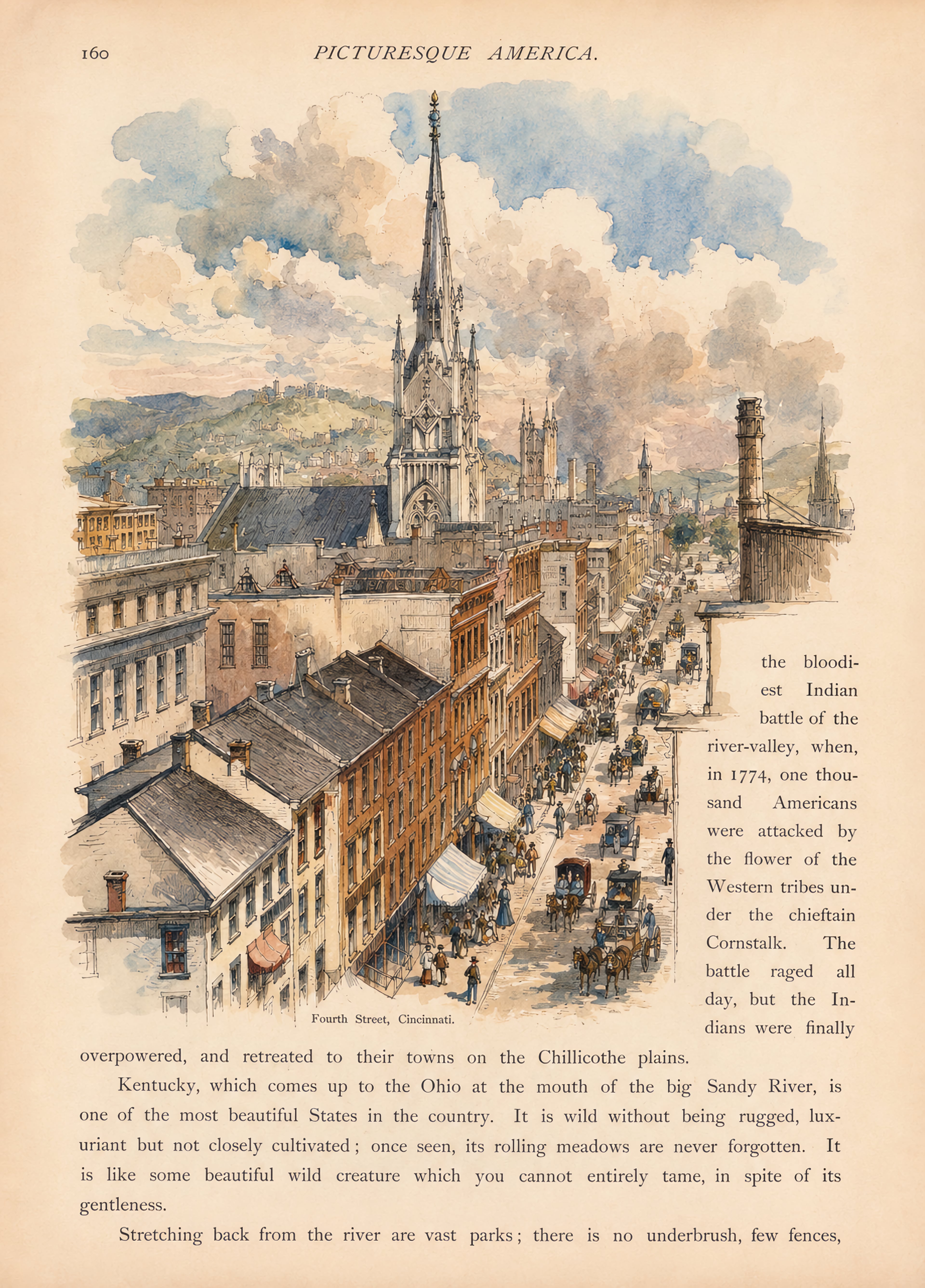
In between: Alfred Rudolph Waud's 1872 street scene in Over-the-Rhine, published in Picturesque America. Henry Mosler's 1862 illustration of Union volunteers crossing the Ohio on a bridge of coal boats, the actual Roebling towers visible in the background, still under construction. The 1884 Frank Leslie's engraving of the Cincinnati Courthouse Riots, which killed 56 people over three days and ended in the complete destruction of the Hamilton County Courthouse by fire. Jacob Gervis's 1869 Harper's Weekly study of a wharf boat, that essential piece of 19th-century river infrastructure that let steamboats dock regardless of the season's water level.
Each print is a snapshot of a city changing faster than any previous generation had experienced: from frontier outpost to industrial metropolis in the span of a few decades.
The Idea
The goal was simple: show where each artist stood. Most of these views were drawn from specific, identifiable locations: the top of Mt. Adams, the Kentucky bank at Covington, a window at the Carlisle Hotel on Fourth Street. Placing each one on a modern map lets you look at what's there today and measure the distance between the city these artists saw and the one that exists now.
Some landmarks are still recognizable. The river is the same. The hills are the same. The Roebling Bridge is still there, looking almost exactly as it did in the 1876 Harper's Weekly centennial panorama.