
Zambian National Conservation Compliance Assessment for COMACO
Partners


I had the privilege of joining COMACO's Chipata office during my time with Peace Corps Zambia. During my time there, I was embedded as a digital support resource for the organization's data, communications, and conservation programming.
COMACO works at the intersection of smallholder agriculture, market access, and wildlife protection, and, at the time, they needed someone who could document and communicate field data to a larger audience. Working out of Chipata in Eastern Provine put me much closer to both the farming communities and government ministries that COMACO depended on for pulling their compliance data related to wildlife conservation. I helped collect that data, synthesize it, and build charts, graphs, and reports that communicated its importance.
Community Markets for Conservation (COMACO) is a Zambian nonprofit operating in the Luangwa Valley and surrounding districts. It works with tens of thousands of smallholder farmers, providing training in sustainable agriculture and access to premium markets through its It's Wild! brand. COMACO's model ties agricultural pricing to environmental compliance — rewarding communities that protect forests and wildlife with better income.
Conservation Markets and the Compliance Gap
In Zambia's Luangwa Valley, farming communities and the wildlife that surround them share the same land. Charcoal production, slash-and-burn agriculture, and persistent poaching have steadily eaten into forest cover and the habitat for wildlife populations across Eastern Province.[2][3] Zambia ranks second in Africa and fifth in the world for absolute annual forest loss, and in food-insecure years more than half of Valley farmers have been documented setting wire snares for wildlife.[7]
Community Markets for Conservation (COMACO) was built on the simple premise that farmers who adopt sustainable practices deserve better prices for their crops, and connecting conservation behavior to market outcomes can succeed where enforcement alone hasn't historically.[1][7] Through its It's Wild! product line, COMACO offers premium markets to farmer cooperatives who demonstrate verified conservation compliance. COMACO also pays a "conservation dividend" to compliant producer groups just before the lean season.[7] The COMACO model aims to turn stewardship into an economic advantage for farmers who deserve it.
But the whole system depends on one input: an honest, methodologically sound assessment of which communities are actually conserving. Without it, the pricing signal that drives everything loses its legitimacy.
Conservation through markets only works if the market signal reflects real behavior on the ground.
The Data Problem Behind the Market Model
COMACO's model is only as credible as the data behind it. To pay premium prices to farmers who conserve, the organization has to know, with confidence, which communities are actually conserving. That meant building a methodology from scratch.
If you can't measure conservation behavior reliably, the pricing signal that drives the whole system collapses.
Wildlife Populations: South Luangwa Valley (1973–2024)
Each species shown as % of its 1973 population. Drag the slider right to reveal what happened next.
Sources: IUCN African Elephant Database (AED) aerial survey records; CITES MIKE Carcass Summary 2003–2024; Zambia Department of National Parks & Wildlife (DNPW); South Luangwa Conservation Society annual wildlife monitoring reports. Pre-2003 figures are survey-period estimates with inherent uncertainty.
The compliance data COMACO needed lived in three separate government ministries (Forestry, Wildlife, and Agriculture), each tracking different indicators in different formats, at different geographic scales, with different levels of completeness. There was no existing framework for pulling them together, no shared definitions, and no precedent for the kind of cross-ministry synthesis the assessment required.
The fragmentation runs deeper than format. Eastern Province operates through both district government and traditional chiefdom authority, and the two don't always line up. A district might report aggregate wildlife data, but COMACO's pricing decisions have to reach the chiefdom level, where chiefs and chieftainesses hold real authority over land use. Mapping government data to traditional boundaries takes local knowledge and relationship-building that no dataset can supply on its own.
The credibility stakes are high. If the assessment overstates compliance in a district, communities get paid premiums they haven't earned, and the whole pricing signal degrades. If it understates compliance, farmers who genuinely committed to conservation get penalized. That's not just a technical risk; it's a trust problem that compounds across thousands of farming families and the dividend they're expecting before the hungry season.[7]
COMACO's pricing model creates direct financial consequences for the communities it assesses. An inaccurate or inconsistent methodology doesn't just produce bad data, it erodes the trust that makes the conservation incentive work in the first place.
Building an Assessment System from Scratch
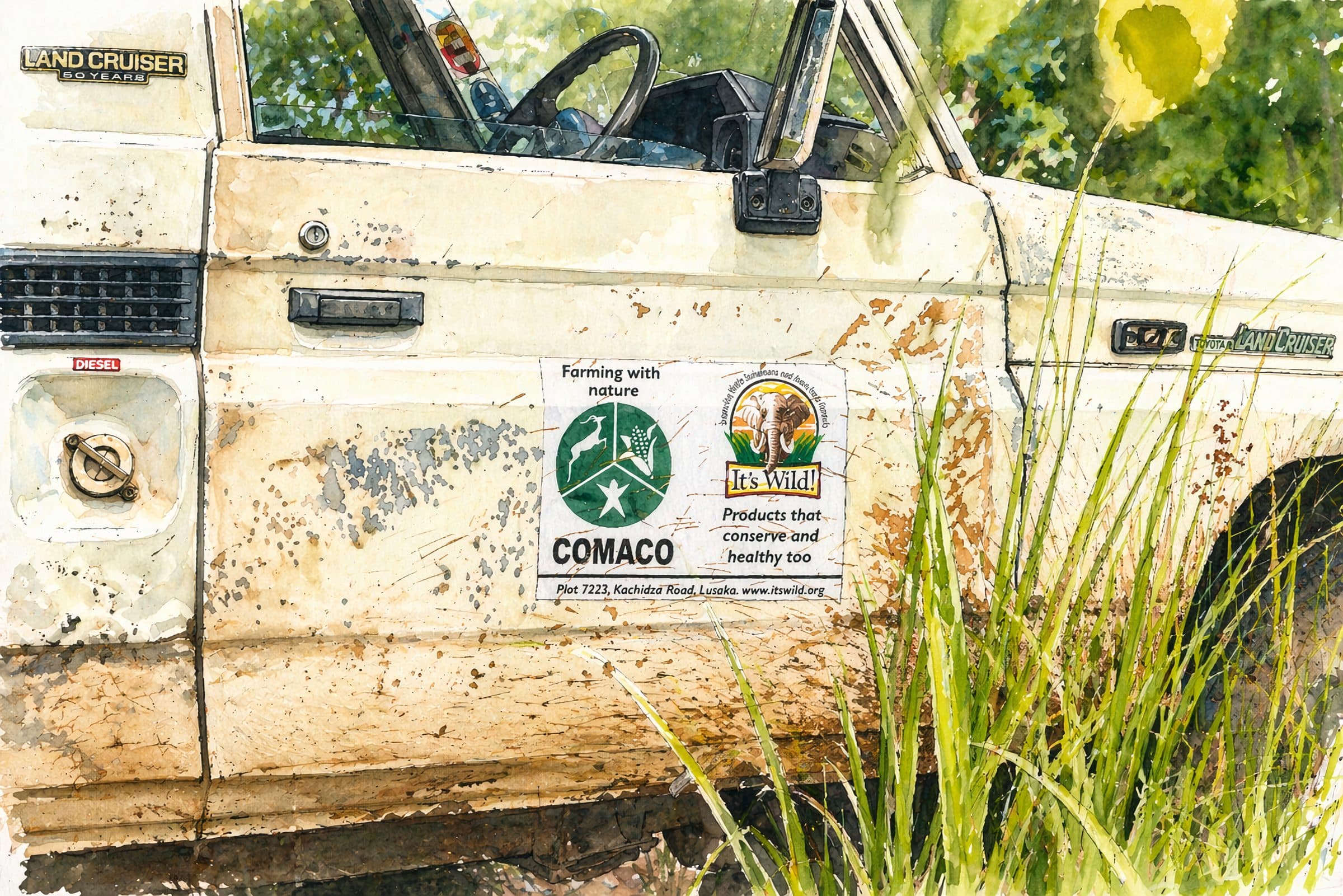
I was tasked with building a comprehensive report that would communicate COMACO's compliance efforts across the Zambian landscape. At the time, there wasn't an existing template for a COMACO national conservation compliance assessment, the work also involved designing a methodology capable of quantifying conservation performance at the district and chiefdom level. This involved aggregating data from multiple government agencies, normalizing it, translating it into comparable scores, and producing reports COMACO could actually use to adjust its pricing for those producers.
Over three months, I personally sojourned to the Zambian Ministry of Forestry, the Ministry of Wildlife, and the Ministry of Agriculture to collect their operational data. Admittedly, even finding the best individual to hand that data off to me was a challenge.
As you might suspect, each ministry tracked different indicators in completely different formats. Reconciling those into a unified dataset required a significant amount of data massaging, interpretation, scripting, and cross-referencing.
The assessment framework covered three critical domains:
Anti-Poaching Performance
- Number of elephants killed in each district during the assessment period
- Volume of snares surrendered by community members
- Number of illegal firearms surrendered
Forest and Land Use Compliance
- Deforestation rates and incidence of illegal charcoal burning
- Adoption of COMACO-approved sustainable farming practices
- Reduction in slash-and-burn incidents
Institutional Readiness
- Whether districts had developed formal conservation plans
- Whether those plans had been officially approved and were active
Traditional chiefdoms operate alongside, and sometimes independently of, district government structures. A chief holds significant authority over land use and local compliance. Assessing conservation at the chiefdom level, not just the district level, was essential for COMACO's pricing decisions to be both accurate and culturally legitimate.
Each district produced over 350 individual data points. Standardizing, verifying, and weighting these across multiple districts while still accounting for differences in reporting quality between ministries and regions, really formed the core analytical challenge of the project.
The Assessment Reports
The project produced the COMACO Conservation Assessment Reports, which was a set of district-level documents outlining each area's performance across the anti-poaching, land use, and institutional readiness domains. These reports became a primary input into COMACO's pricing and program decisions, giving the organization a defensible, data-grounded basis for differentiating market prices by conservation performance.
- Standardized scoring across districts and chiefdoms, enabling direct comparisons for the first time
- Multi-domain coverage integrating wildlife, forestry, and agricultural data into a single composite assessment
- Actionable outputs structured to inform COMACO pricing decisions at the district and chiefdom level
- Institutional relationships built with three government ministries, establishing data-sharing pathways that could support future assessments
The conservation economics literature increasingly supports COMACO's model. When communities have a direct financial stake in environmental outcomes, compliance rates improve in ways that enforcement-only approaches rarely achieve.[5][6] The assessment created the feedback loop that makes the incentive structure credible.
The work also established a replicable process: by documenting the methodology, data sources, and scoring weights, the reports made it possible for COMACO to conduct future assessments without rebuilding the framework from scratch each time.
COMACO's model and operations are documented through the It's Wild! website (2023). Zambia's deforestation context draws from the FAO Global Forest Resources Assessment (2020). The community-based wildlife management framework is grounded in Lewis (1995), a foundational study from the Luangwa Valley. General Zambia governance and infrastructure context from World Bank (2022). The case for market-based conservation incentives is supported by Roe et al. (2009) and Newmark & Hough (2000).
- COMACO. (2023). Community Markets for Conservation — It's Wild!. It's Wild! by COMACO, Zambia. [Link]
- Food and Agriculture Organization of the United Nations. (2020). Global Forest Resources Assessment 2020: Country Report — Zambia. FAO, Rome. [Link]
- Lewis, D.M.. (1995). Importance of GIS to community-based management of wildlife: lessons from Zambia. Ecological Applications, 5(4), 861–871. [Link]
- World Bank. (2022). Zambia — Country Overview. The World Bank, Washington DC. [Link]
- Roe, D., Nelson, F. & Sandbrook, C.. (2009). Community Management of Natural Resources in Africa: Impacts, Experiences and Future Directions. Natural Resource Issues No. 18, IIED, London. [Link]
- Newmark, W.D. & Hough, J.L.. (2000). Conserving Wildlife in Africa: Integrated Conservation and Development Projects and Beyond. BioScience, 50(7), 585–592. [Link]